Account of my cultivation journey with the Tian Guo Marching Band
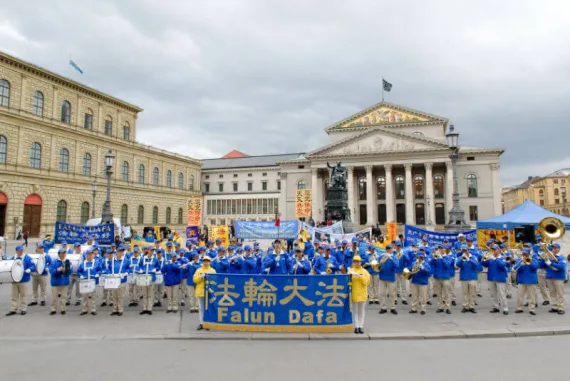
My name is Maya, I am of Bulgarian origin, and I obtained the Fa in 2006. I would like to share with Master and my fellow practitioners, in the form of a narrative, my cultivation journey over these years in the band.
My beginnings at the Tian Guo Marching Band
The first time I saw the Marching Band was during the parade in Paris, 2008. Before the parade began, I was handing out flyers to the drivers of the cars that stopped at the traffic lights close to us. Many of them asked me who we were and what the event was about. Once the march started, I couldn’t help but stay close to the front of the parade, where the band was. Although I kept moving around, I just wanted to be close to the band. I felt an overwhelming sense of emotion and something I could not put into words. Six years later, I understood why. In 2013, I became a member of the Tian Guo Marching Band.
My first trip and participation took place in Copenhagen in 2013. I knew that I was not yet fully prepared and that I did not play the flute fluently. However, several events made me realize that Master was giving me hints to keep going.
The first occasion was when I was about to board the plane to travel to the event. It turned out that many of us who were traveling in second class were upgraded to first class at no additional cost. The flight attendant was so curt that I did not dare ask her the reason for this change. The second occasion was just minutes before the parade was about to begin, when we were told that the entire orchestra would be photographed in a nearby square, as a photographer from the United States had come specifically for the occasion.
I asked a fellow practitioner from Spain, who was a member at the time: “How am I going to take photos if I haven’t even participated yet?” He simply smiled at me and said, 'Just stand there and don’t think about it.'
That was where I began my incredible journey with the Tian Guo Marching Band. My first rehearsal took place in Wiesbaden. To this day, I remember that when we finished and I left to return to my country, I thought: 'Being in the Marching Band is another level of cultivation.'
The challenges with my flute
One of the challenges I encountered was finding a good teacher and learning the proper technique to play. My first teacher was not very skilled in this regard, but she valued me as her student and often played Dafa songs with me. She also helped me spread the practice among her students and family members.
Almost two years later, I found one of the best music teachers in my city, and thanks to him I was able to correct many bad habits and postures I had developed. At that time, it was very difficult for me to produce a smooth and clear sound; many times I did not have enough breath to hold long notes. I would practice for hours on end, yet I still did not achieve much. But one day, after passing a xinxing test while playing the flute, I noticed that something had changed and I had improved. This encouraged me to continue. I realized that my progress in cultivation was the key to playing better and better.
At that time, I had to deal with my colleagues in my work place and faced many tests. Sometimes I passed them, and other times I did not, but I always did my best to improve in the cultivation.
Another challenge I faced was memorizing the notes of the songs. I remember that at the beginning, during a parade in Hamburg, I had a stand strapped to my arm to read the notes. From the very start to the end of the parade, the stand kept falling constantly. In the end, I realized and thought to myself, “It’s time to memorize them.” In fact, I found it easier to memorize the more complicated songs, such as 'Thank You Master' and 'Fo En Sheng Yue,' than the others.
During these years, I changed my flute twice. The first was a Yamaha belonging to a 12-year-old boy, and the second one was a patent belonging to my current teacher. Both times when I received them, I felt incredibly happy. I took great care of them and made sure they were in good condition.
Looking inward during the parades
It is a bit difficult for me to say how many parades I have participated in, but each one has helped me improve my playing skills, understand the music, and look inward. There is a significant difference in my attitude during parades from the beginning until now. At first, since I was not yet well-trained and prepared, I would easily get distracted by what was happening around the band and paid little attention to our drum major. It was like an invisible path that gradually led me to look inward rather than outward during the marches.
I used to watch what my fellow practitioners were doing and whether they were talking or not. Deep down, I wanted control. My attachment to control has manifested many times over this period. I think it is acceptable once in a while to remind a fellow practitioner to fasten a button on their pants, or to tie up their hair properly, etc. But doing it constantly is not right.
Also, I felt irritated when a fellow practitioner in front of me made constant mistakes during the march, did not march in unison with the others, or was not attentive to the drum major’s signal to raise his/her instrument, at the start of a song, and so on.
Another point is when local fellow practitioners who are supporting or providing security sometimes march at the beginning of our rows or are in a hurry to pass and sometimes even push us without realizing it. Surely, there were many more things that annoyed me, but I will stop here because my intention is not to complain but to look inward.
I don’t know exactly when, but a few years ago I realized that this kind of attitude was not correct. I began reciting Lunyu each time we were ready to start the parade. If I notice something wrong at a particular moment, I point it out, but I no longer intentionally watch for it as I used to.
Now, my focus is on the drum major and the signs he gives us. In this way, my performance is much better; I don’t forget the notes, I’m on the right beat, and my mind doesn’t wander. I also often recite Master’s jingwen, “Tian Guo Marching Band” (2015) whenever I notice that my mind isn’t focused.
“Drums and horns of Fa display divine might
Purging all manner of evil,
beckoning souls back to heaven
Heaven n’ earth are in awe
as the Band saves lives at the end of time
Its glorious light shines
in the cosmic Fa-rectification”
One year, we were scheduled to have a parade in Prague. I arrived a day earlier and stayed in the apartment of a Vietnamese fellow practitioner, where many other Vietnamese practitioners were already lodging. We were all gathered in one living room and sleeping on the floor, but one of them would not stop talking. After enduring it for quite a while and feeling very irritated inside, I told her that I was trying to study the Fa, and that it was impossible for me to concentrate.
She was not a member of the band, and I did not know her, so when I asked her to be a little quieter, she became upset. All the other fellow practitioners also looked at me disapprovingly. I continued studying the Fa and calmed myself.
The next day, I had to go to the hotel where the whole band was staying for rehearsals, together with two other Vietnamese practitioners (Practitioner A and Practitioner B). They were carrying a large suitcase filled with vegetables and exotic fruits, which they could barely move. When we arrived at the bus stop, there were some signs announcing something, but everything was only in Czech, and we could not understand what it said.
I asked someone if we were heading in the right direction, and they told me yes. We boarded the bus, but after we had passed one stop, another person told us we had to go in the opposite direction and that we had gone the wrong way. Then, the two fellow practitioners had to carry the heavy suitcase down and up again. This happened more than five times—we kept boarding and getting off buses, only to be told each time that we were going the wrong way.
This greatly angered the two practitioners carrying the heavy suitcase, and they kept speaking negatively about me in their language, looking at me with frustration. Even though I was making every effort, constantly asking local people—who spoke only their own language—for help, there was no way to find the correct direction. Suddenly, I stopped and told them, "Stop talking and start sending forth righteous thoughts, or I will leave you here." They both went silent, and we began sending forth righteous thoughts.
At that very moment, I met a young man who spoke English, and he told me that to get to the hotel, the route of the first bus had been cut off, and at a certain point, we had to transfer to another bus. He showed us where to get off, and finally, we were on our way.
When we were about to take the second bus, Practitioner A made a negative remark that upset me again, and I told her, "Open your Google Maps, and now you guide us to the hotel." She went the wrong way, and again, we lost precious time needed to arrive on time for rehearsals. At that moment, I could not look inward, but when we finally arrived at the hotel, I calmed down and thought, "What was I supposed to learn from this incident? Where did I go wrong?"
The truth is that when I first saw my fellow practitioners carrying that large suitcase of vegetables as we left the house, I thought, "Are we going to the rehearsal or to the marketplace?" I already had a negative thought toward them. My attitude the previous night had also not been good; when I told the other practitioner to keep quiet, my words were not kind. All of this triggered and turned into interference.
Later, in the hotel, in a calm state, I remembered Master words:
“But often tensions like these won’t count or achieve what they are meant to, or help you to improve, if they don’t actually bother you.”(Lecture Four, Zhuan Falun, 2018)
When I had the opportunity, I approached Practitioner A, who was from my flute section, to apologize. I also apologized to Practitioner B, although she seemed much more upset with me; she eventually accepted my apology.
That incident reminded me that, as a Dafa disciple, I must always look inward, no matter the situation, measure my words, and evaluate everything with the Fa. Anger is not a good state for a cultivator and all this happened to help me elevate my xinxing.
Challenges During This Year’s Parades
This year’s parade in Rotterdam was very challenging. It had been a long time since I experienced so many interferences during a march. Suddenly, air would enter my flute and I could not play; I would forget the notes, and despite my greatest efforts to stay focused, I could not. I also felt sleepy. My legs felt like two stones, and it was difficult to lift them. We were standing still, and I saw another practitioner’s eyes closing. I thought, 'The battle in other dimensions must be tremendous.' I began reciting Linyu, and gradually the interference subsided.
We also faced many challenges during the parade last July in London. The rain that accompanied us throughout the first part soaked all our clothes, shoes, gloves, and instruments. The wind also blew fiercely, and the interferences were rampant, yet they achieved nothing. We completed our parades successfully.
There are many experiences like these, and our mission is to assist Shifu in saving sentient beings. Despite all the challenges, the streets were filled with people, applauding, enjoying our music, and some even dancing with joy. These are the moments that make me forget all discomfort, pain, and misfortunes. Many times, I am moved to tears, and I remind myself: "Don't cry, otherwise you can't play."
Final Thoughts
I would like to express my gratitude for the tireless efforts of the coordinators, which have helped us improve our musical level and elevate the band to the level we have today. I also want to thank all the fellow practitioners who have accompanied me throughout these years and helped me improve in my cultivation.
During the Fahui in Madrid in 2014, I shared these words in my experience: “For me it is a great honor to be part of the Tian Guo Marching Band,” and twelve years later I feel and repeat the same words.
To conclude my experience, I would like to share Master’s jingwen, “Tempering One’s Heart and Will” (English Translation Version B):
Tempering One’s Heart and Will
Reaching Consummation, obtaining Buddha’s Fruit, Eating bitterness treated as joy. Toiling the body does not count as bitterness, Cultivating the heart is most agonizing. Each and every barrier must be broken through, Here and there, demons are everywhere. A hundred hardships falling all at once, See how one lives. Able to endure suffering in the world, Transcending the world, is a Buddha.
If there is anything inappropriate in my article, please kindly point it out.
Thank you, Master! Thank you, fellow practitioners!
More experience reports
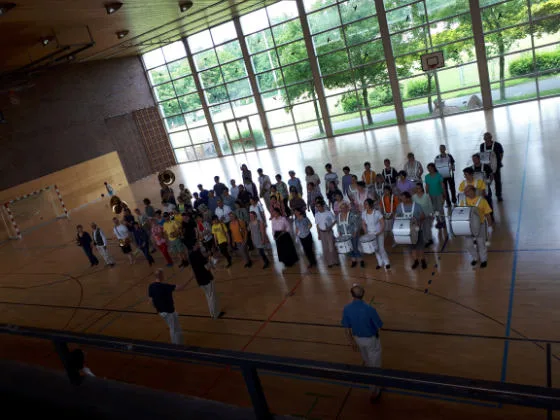
A Trumpeter's Growth path - Continuously improve skills and contribute to the whole Band
Greetings fellow practitioners of the Tianguo Marching Band.
Read more »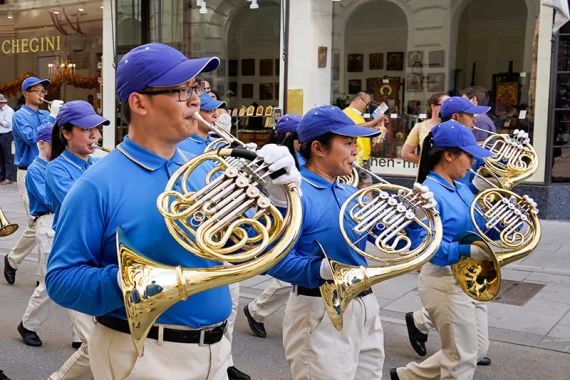
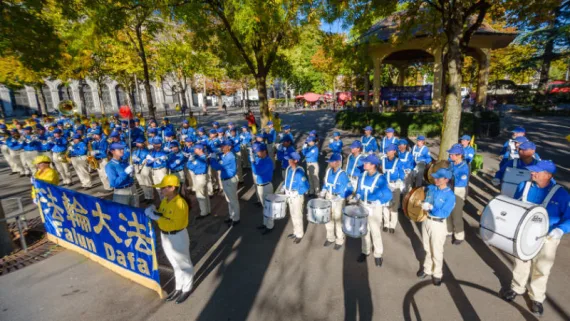
Cultivation as a Member of the Tian Guo Marching Band
Dear Master, dear fellow practitioners,
Read more »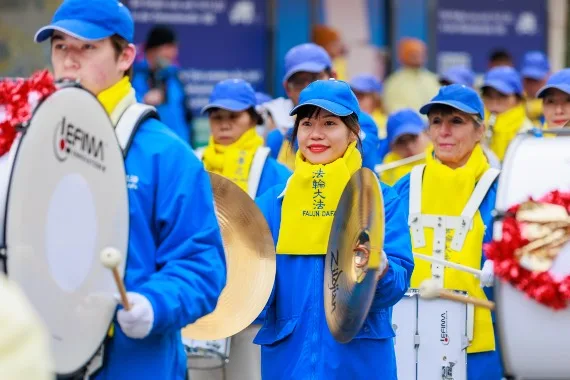
How joining the Tianguo Marching Band changed me
I was born into a family of Falun Dafa practitioners, and from a young age my parents told me that “Dafa is good” and that cultivation is very important. When I was little, they often studied the Fa a...
Read more »
Master is Right Beside Me
I first saw the Tian Guo Marching Band in Frankfurt in 2019. At that time, I had no thoughts of joining the band, because I had no musical background and felt that this project had little to do with m...
Read more »