Cultivation in the Tian Guo Marching Band
dear fellow practitioners,
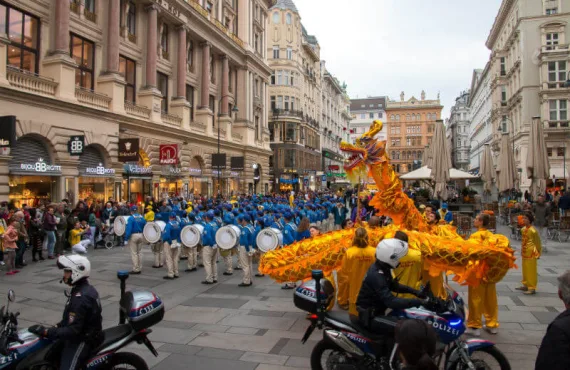
in 2018, I joined the snare drum section of the Tian Guo Marching Band.
Through nearly twenty years of cultivation, I have strived in daily life and at work to conduct myself according to the principles of Truthfulness, Compassion, and Forbearance. Because of this, I have generally been able to maintain good relationships with ordinary people, with few conflicts or arguments. I truly enjoy participating in the activities of the Tian Guo Marching Band, as it provides a wonderful opportunity to cultivate and elevate myself together with fellow practitioners.
Physical challenges
When I first began participating in band activities, I found it quite challenging. During parades, I had to concentrate on playing the music, but while marching on the streets, I also had to pay attention to the conductor’s baton, the ground surface, and any obstacles ahead. On top of that came the reactions of bystanders and various other factors. All of these made it difficult for me to focus my mind completely on playing. I often had to remind myself to stay focused.
After marching for some time, I felt that the drum harness put a great strain on my shoulders, especially my left shoulder. The pain sometimes became so severe that my left arm’s movement was restricted. In Hong Yin I — “Tempering One’s Heart and Will” (No. 1) — Master says:
„A hundred hardships falling all at once,
see how one lives.“
I thought to myself: This is just a little physical pain, far from ‘a hundred hardships.’ It would surely disappear after a few days. Indeed, by the next morning, the pain usually subsided and hardly affected my playing.
In the second year, however, my shoulders would ache for about a week after each parade. After the last performance that year, the pain lingered for a long time. Whenever I lifted my left arm to a certain position, I felt pain in the shoulder — a condition that lasted nearly a year. At first, I didn’t take it seriously, but gradually I began to worry: Is this still normal?
During a conversation with a fellow practitioner, I mentioned that this physical condition had persisted for quite some time. She told me that she had gone through the same phase earlier. Surprised, I asked, “What phase?” She explained that when she first joined the band, she often encountered various forms of interference before each performance — physical pain, xinxing tests, family conflicts, or difficulties with travel. But she insisted on participating in every activity. Over time, things went more smoothly. Even when problems arose, she could quickly view them with righteous thoughts and not be affected, ensuring that the band’s performance was not hindered.
In Zhuan Falun (Lecture Seven), Master says:
„Particularly for a practitioner, in the course of cultivation practice you are given some tribulations at each different level. They all come from your own karma and are your own tribulations, which are placed at different levels for you to upgrade yourself.“
I thought: Why should I worry? This is my own karma being eliminated — it’s a good thing!
In the third year, the pain suddenly disappeared, allowing me to participate in Dafa activities without disturbance. Today, I still sometimes feel slight pain in my left shoulder during parades, but it is much lighter than before.
My understanding of the exercises
I am not able to do the exercises every day. Therefore, I am very grateful during band gatherings when fellow practitioners motivate me to practice together in the morning. Since we stay together, getting up early becomes much easier. During the exercises, I always strive to perform the movements correctly, so I occasionally check my posture.
During the second exercise, I felt that both of my hands were facing each other above my head in the correct position. However, when I opened my eyes, I saw that my right hand was higher and farther forward than my left. After correcting it, it then felt — with my eyes closed — as if my hands were uneven again. I began to wonder whether my own perception was flawed.
Master says in Zhuan Falun (Lecture One):
„Some people go by how they feel in practicing something. What does your feeling account for? It is nothing. The actual transformation process takes place in other dimensions and is extremely complex and intricate.“
We often think we know our bodies well, but in truth, there are perceptible discrepancies in our limbs. The practice clearly revealed how inaccurate our perception can be. This led me to reflect on other aspects of life: If I am convinced about something, or think I know it for sure — could I be just as wrong? I realized I should be more humble and ask myself more often whether I might be mistaken.
The process of correcting my posture during the exercises is also a process of rectifying my understanding and elevating myself.
Each time I practice, I carefully follow Master’s words and try to perform the movements precisely. During the third and fourth exercises, I often find that when my mind drifts, my movements become faster than Master’s instructions. Therefore, I remind myself to stay focused and follow Master’s words closely.
When several practitioners practice together, our movements are sometimes not synchronized.
In the Fa Teaching at the First Fa Conference in North America (1998), Master said:
„But that said, when you do the exercises, the speed should be more or less the same as the audio tape recording. The movements should be the same and well synchronized when you do them as a group.“
If everyone follows Master’s words, there will be little deviation. Each of us should take Master’s requirements seriously. The fifth exercise is the most difficult for me. In the beginning, I could only sit in the single lotus position for 15 minutes. After more than ten years, I gradually managed to sit in the double lotus position for one hour. Over the years, I sometimes doubted whether I could achieve this at all — whether my physical condition was sufficient. I even envied other practitioners who could sit in double lotus with ease.
In the Fa Teaching at the Conference in Houston (1996), Master said:
„The requirement is to achieve full-lotus ultimately. Practice it gradually, and everyone will be able to sit in full-lotus. In China elderly people over eighty years old have been able to gradually cross both legs, so there won’t be a problem. As long as you practice, you will gradually manage to cross them.“
I told myself: I trust Master and the Fa. I should not look for excuses — I should just keep practicing and eliminate karma. One day, I will surely achieve it.
In daily life, I try to sit in the lotus position when studying the Fa or during other occasions. On days filled with Dafa activities, my legs sometimes burn and my body feels tired, but sitting in lotus often brings quick recovery. At first, the pain was so intense that I could hardly manage the double lotus position. Yet, through this pain, I sensed a kind of expanding lightness. After a few minutes, the pain quickly subsided, energy flowed throughout my entire body, and I felt wonderful — my strength returned rapidly.
The duration I could stay in full-lotus position increased significantly, which was closely related to a breakthrough in my xinxing. As Master says in Zhuan Falun, Lecture 1:
„Once you upgrade your xinxing, your body will undergo a great change. Upon xinxing improvement, the matter in your body is guaranteed to transform.“
Conflicts are opportunities to look inward
When practitioners work together, conflicts inevitably arise — but they are also precious opportunities for cultivation and elevation.
During one band activity, I had a discussion one evening at the hotel with a fellow practitioner about the quality of hotels we had stayed in that year. There was one particular hotel in a certain city that I was especially dissatisfied with. I stubbornly complained that the local practitioners always chose the same hotel out of convenience. The fellow practitioner tried to offer another possible explanation, but I interrupted her and insisted on my own opinion. At that moment, I did not realize that behind my judgment lay my own attachment to comfort. The next morning, I went to the practice site and happened to meet practitioner A from that city. Seeing an opportunity, I gave him feedback about the hotel. He listened but did not accept it. Instead, he explained how difficult it was to find a suitable hotel. He also said, “Your logic is not right.”
I was puzzled — what did logic have to do with feedback about hotels? Yet inwardly, I felt stirred. Fortunately, the exercise music started just then, and our uncomfortable conversation ended.
During the exercises, I thought: We are all cultivators. When conflicts arise, we should not look outward but inward. I asked myself: Where was I illogical? Immediately, a thought came to me: My premise was wrong.
The night before, I had insisted that local practitioners were lazy, and that’s why the band had stayed in the same poor hotel multiple times. But that premise was false! Practitioner A had not heard what I said the night before, yet he directly pointed out my problem. Wasn’t this Master using his words to give me a hint?
I should not have harbored such negative thoughts or complaints — not toward fellow practitioners, nor toward anyone or anything. Everything that happens has its reason. In the process of cultivation, we are to recognize and eliminate our attachments, change human notions, and elevate our level. Even though it was a small matter, through it I recognized my attachments to comfort and resentment.
In cultivation, nothing is trivial. The band provides us not only with an opportunity to save sentient beings through music, but also a valuable environment for our own cultivation. I am deeply grateful for Master’s compassionate arrangements and for the help of my fellow practitioners.
These are some of my understandings and experiences. If there is anything inappropriate, please kindly point it out.
Thank you Master!
Thank you fellow practitioners!
Heshi!
More experience reports
A Trumpeter's Growth path - Continuously improve skills and contribute to the whole Band
Greetings fellow practitioners of the Tianguo Marching Band.
Read more »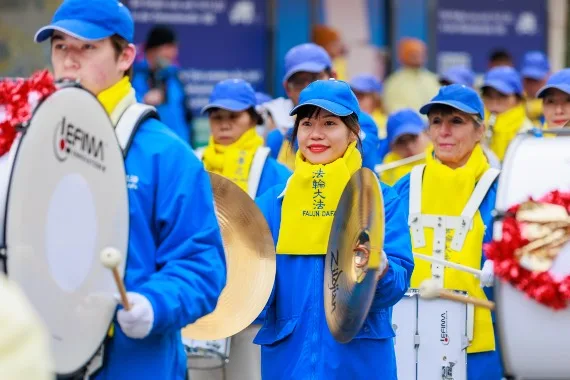
How joining the Tianguo Marching Band changed me
I was born into a family of Falun Dafa practitioners, and from a young age my parents told me that “Dafa is good” and that cultivation is very important. When I was little, they often studied the Fa a...
Read more »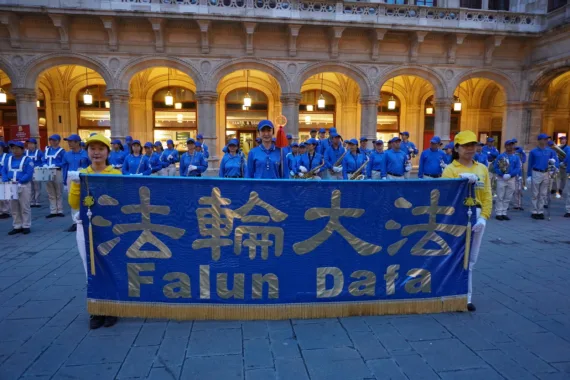
My Cultivation Journey With the Tian Guo Marching Band
I joined the Tian Guo Marching Band around June 2007. Initially, I didn’t know that I was to coordinate the marching band for the UK, and that we were to become part of the European Divine Land Marchi...
Read more »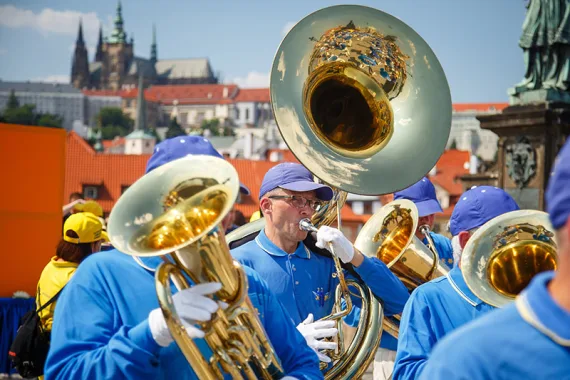
Prioritizing cultivation and the salvation of living beings
Greetings to Master. Greetings to fellow practitioners.
Read more »