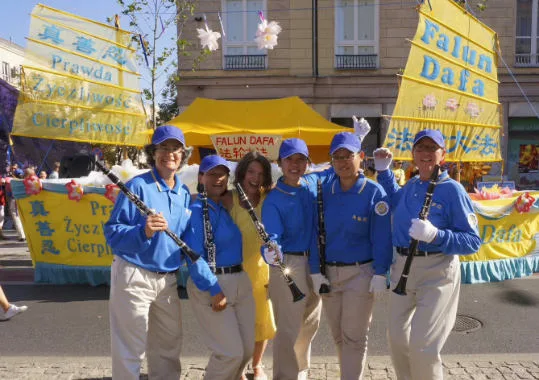
Cultivation Journey of Joining the Tian Guo Marching Band
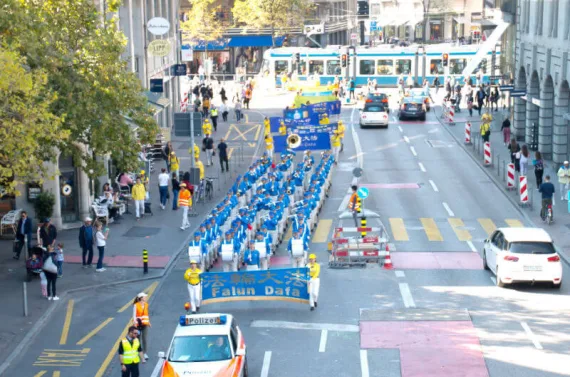
My name is Lan, and I currently live and work in the Czech Republic.
In order to contribute to the Fa Conference to share cultivation experiences, and also to look back on my cultivation process since joining the Tian Guo Marching Band, I would like to write a sharing
1. The process of coming to The Tian Guo Marching Band
In 2018, when the European Fa Conference was held in the Czech Republic, the band came to Prague. During the parade before the Fa Conference, I happily volunteered to carry a banner for the group. Throughout the entire parade, I listened to all the songs. The music of the band truly moved me and filled me with admiration.
After the Fa Conference, the band continued their parade tour to several neighboring countries, and a few practitioners from the Czech Republic went along to support them. When they returned, they shared with us that the band was in need of new members. Several of us were very eager to join.
So, at the end of 2018, a group of five of us from the Czech Republic decided to travel to Germany to apply to join the band. On the way, we were full of excitement. We discussed how none of us had studied music as children, so we probably wouldn’t be able to play complex instruments, but perhaps we could play the drums, which must be easier to learn.
When we were asked, “Which instrument would you like to play?” all five of us said, “We want to play the drums.”
But in the very first test—clapping along to the beat—only one of us passed, and it wasn’t me. We were then asked to try several other instruments. In the end, I and one other practitioner were advised to learn the saxophone, while the others were each assigned different instruments.
During the three days we stayed with the band, the music coordinators taught us some basic music theory. I realized how complicated it was! The notes seemed so difficult and confusing. The coordinators told us that we must find a music teacher back home and study seriously.
On the way back, our mood was completely different from when we went. We were anxious about the instruments we had been assigned. Where should we start? How should we practice? Could we even do it? But we told ourselves: we have to try!
At the beginning of 2019, I managed to buy a saxophone. When I opened the case, I didn’t even know how to assemble it or how to hold it properly.
The first step was to find a teacher. I even flew back to Vietnam for two weeks just to take lessons. After 8–10 days of lessons, I had learned a little bit of the basics. My teacher also recorded sample playthroughs of the parade pieces so that I could take them with me and practice on my own, since my time was so limited.
2. My Music Practice Process
After returning to the Czech Republic, it took some time before I found a teacher who agreed to teach me at home. I was very happy when he agreed. He didn’t have much time, so he could only teach me once every one or two weeks.
When he came, I told him honestly that I didn’t know much yet, but I wanted to be able to play these songs (I showed him the parade sheet music). He told me that I first needed to study the fundamentals and that it would take at least two years before I could play those pieces.
He taught me the basics according to his own plan for beginners.
I was impatient and wanted to start playing the parade music as soon as possible. Sometimes I practiced the band’s pieces on my own and asked him to play them so that I could follow along. Sometimes I could manage when playing together with him, but when playing alone, I often made many mistakes.
After a few months, the teacher went on Christmas and New Year holidays, and then the COVID-19 pandemic came. Since he had a small child at home, he told me he could no longer continue teaching me.
After that, I stopped practicing as well. I felt that it was too difficult to study alone, and I was afraid that if I learned incorrectly without anyone to correct me, it would be very hard to fix later. I comforted myself by thinking that, at least, I could still hold a banner for the band during parades.
As my job got busier, I neglected my practice even more. Sometimes I felt guilty when I looked at my saxophone, so I would take it out and play a little, then put it away again. Sometimes two or three weeks—or even months—passed without touching it.
One day, at the end of August 2020, the practitioner who had started learning the saxophone together with me called to say that she had already recorded and submitted her first five pieces. I thought to myself, “That’s so daring of her,” because I knew she mostly practiced alone.
A few days later, she told me that she had passed and showed me the message. I was truly shocked —she had done it! She told me that she often got up at 4 a.m. to practice.
I deeply admired her and turned my thoughts inward. I realized that I had been wrong for not trusting in my own ability and for always wanting to rely on others—always waiting for a teacher to guide me, and thinking that without one, I could not succeed.
I also saw many human attachments and postnatal notions that I needed to eliminate: the attachment to showing off, jealousy, and the thought that I was more capable than she was because I had studied more seriously when we had a teacher. And yet, she, with fewer lessons and language difficulties (I even had to interpret for her during lessons), had persevered on her own and passed the first test to stand in the marching band.
I felt ashamed of my earlier thoughts, admired her very much, and decided to change. I told myself that for one whole week, I would do nothing except study the Fa, do the exercises, and practice the five pieces until I could record them.
I did record them, but because of my impatience and insufficient practice, I still did not meet the requirements. The coordinator encouraged me to keep practicing and record again before the next parade.
But the pressure of work and music practice together meant that my improvement was small, and again I did not pass. I was, however, encouraged to play with the band at a local performance the next day. This was the Vienna parade in September 2020.
After that event, which was also the last of the year, my will to practice slackened again. It wasn’t until August 2021 that I finally submitted recordings of the five required pieces and passed, becoming an official player. From then on, I no longer carried a banner.
But those five pieces are only the entry requirement—there were six more pieces I still couldn’t play well. They were much more difficult.
I realized that finding a teacher was very important, but so was self-practice. I visited three art schools in my city to ask about lessons. Some schools only accepted children; others gave priority to children because they had few saxophone teachers.
The third school said I could register at the beginning of the school year. But I thought a fixed school schedule would not suit me due to my work, so I asked to meet the teacher directly. I explained my situation, and fortunately, he agreed to teach me in his free hours.
However, I was surprised that this teacher would often get annoyed and even scold me when I made mistakes—and I made mistakes constantly. At first, I thought, “How can a music teacher act like this?” But then I looked within and reminded myself that it was my own poor playing that caused this, and I should endure and keep trying, because it had been so hard to find a teacher.
I remember one time he scolded me so much that he finally shouted, “Play it again!” I was so upset I couldn’t focus anymore, and I cried. I said to him, “Teacher, I really want to learn. I came here to study, not to play around. I know I’m wrong, but I can’t fix it immediately.”
Seeing me cry, he was startled and apologized. He explained that he had some family issues and that he was used to teaching children that way. He promised to try not to scold me again. I also encouraged myself to persevere.
Eventually, those lessons ended because he stopped teaching at the school, and again I was without a teacher.
Later, thanks to Master’s arrangement, a friend introduced me to an online teacher in Vietnam. He was very understanding of adult students with jobs. Whenever I could arrange the time, he was ready to teach. He patiently corrected my mistakes and taught me proper embouchure and breathing techniques.
I truly didn’t want to repeat past situations where, during band rehearsals, I would play out of tune or offbeat and affect the whole group. Sometimes I and other practitioners would be asked to practice separately until we improved enough to play with the band again.
3. What I Have and Have Not Achieved
Since joining the band, I have arranged my work schedule to participate as much as possible, rarely missing training sessions or parades.
I have memorized the pieces and no longer feel nervous during parades. Even when standing in the first row during a stationary performance, I feel more confident.
But I still need to work hard to improve my technique, to play more accurately and beautifully.
Learning music is not easy. It requires persistence, just like doing the exercises and studying the Fa daily. If we do not make it a priority, daily life will interfere with cultivation.
I made a mistake in always prioritizing daily work over music practice, thinking that once I finished my tasks, I would feel more relaxed and play better.
But things never worked out that way. Just when I thought work was done, more unexpected tasks would come. I kept postponing practice to “tomorrow,” and this happened again and again, causing long delays in my progress.
Now I have truly enlightened to the fact that since I am a member of the band, practicing the saxophone is part of my cultivation. If I am not diligent, interference will come and hinder my learning and improvement.
I cannot wait for “Practicing Cultivation After Retirement” (a line from Master’s Essentials for Further Advancement I). This was exactly my old way of thinking — waiting until work was done to practice.
I must eliminate this attachment.
If I put music practice in its proper place with righteous thoughts, I am sure I will succeed. I would like to quote Master’s poem from “The Master-Disciple Bond” in Hong Yin II: “When disciples have ample righteous thoughts,
Master has the power to turn back the tide.”
4. Conclusion
I will treat my music practice seriously so that I can play better and more beautifully, contributing more to the band’s efforts to assist Master in saving sentient beings.
I sincerely thank Master for compassionately arranging for me to become a member of the band.
I also thank the band leader, the music coordinators, and all fellow practitioners who have kindly helped me. This truly feels like a big family to me. The days spent with the band—studying the Fa, doing the exercises, practicing music, sharing, and clarifying the truth—have been days full of joy and happiness.
This is my current level of understanding. If there is anything inappropriate, I kindly ask fellow practitioners to compassionately point it out.
Thank you all for listening.
Prague, September 27, 2025
Quach Hoang Lan
More experience reports
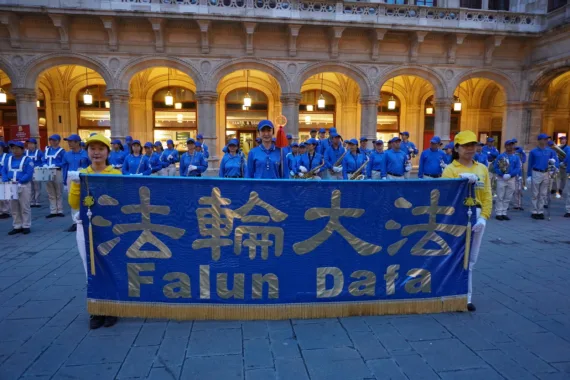
My Cultivation Journey With the Tian Guo Marching Band
I joined the Tian Guo Marching Band around June 2007. Initially, I didn’t know that I was to coordinate the marching band for the UK, and that we were to become part of the European Divine Land Marchi...
Read more »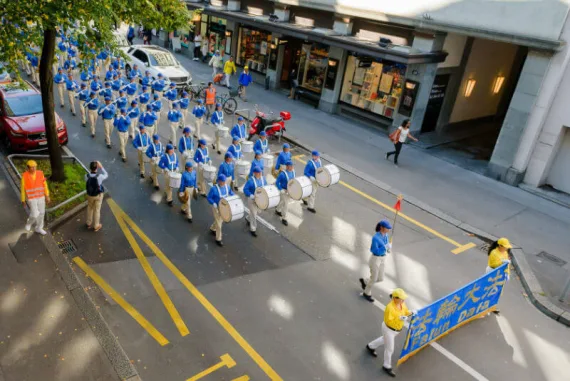
Experience sharing for European Tian Guo Yue Tuan conference 2025
Being a cultivator is a great honour and joy
Read more »
Master is Right Beside Me
I first saw the Tian Guo Marching Band in Frankfurt in 2019. At that time, I had no thoughts of joining the band, because I had no musical background and felt that this project had little to do with m...
Read more »
A Trumpeter's Growth path - Continuously improve skills and contribute to the whole Band
Greetings fellow practitioners of the Tianguo Marching Band.
Read more »