How joining the Tianguo Marching Band changed me
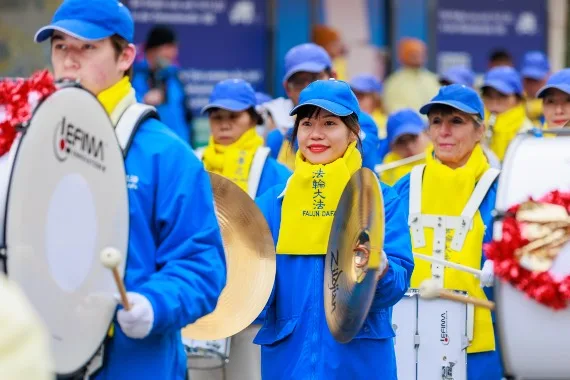
Later, my mother suggested that I should learn an instrument and then join the Tian Guo Marching Band. I didn’t think much about it back then and just followed her suggestion. At first, I joined mostly out of obedience to my parents and because I thought the band looked grand and impressive. I didn’t yet realize the deeper meaning carried by the Tian Guo Marching Band.
When I was still in China, my mom would sometimes take me along to hand out flyers from door to door, trying not to be seen. I was very young, so I didn’t really understand the danger. It mostly felt exciting and fun. Although I knew we were spreading the truth, back then I felt like it was some kind of exciting game rather than a sense of responsibility.
Compared with many other practitioners who are enlightening and strengthening themselves through the pressures, conflicts, and difficulties of ordinary life, I grew up in a Dafa environment where many things naturally fell into place. As a result, I didn’t experience those profound moments of insight or breakthroughs. Because everything came so easily to me, I didn’t cherish it and didn’t cultivate diligently.
As I’ve grown older, I’ve come to understand more and more principles, but because of the laziness I developed from a young age and my lack of deep, personal experience with Dafa, I often fall into a state where I know the importance of cultivation but cannot feel a real sense of urgency, and I know I should strive to improve yet am frequently held back by the comfort of ordinary life.
Around me, there are many more experienced, older practitioners who are very diligent. When I see the good in what they do, my usual reaction is to think, “They are older, so they have more perseverance. I can’t do it; I don’t have their willpower.” But when I reflect carefully, I realize this is just me making excuses for my own laziness—acting as if acknowledging my shortcomings can lessen the guilt I feel for not improving, without working to change myself.
At first, I joined the Tian Guo Marching Band simply because it seemed new and fun. But once I truly participated, I realized that the environment of doing exercises and studying the Fa early in the morning together with many other practitioners was completely different from my usual routine at home. At home, I often struggled to get up early, but in the group environment, I was able to rise with everyone and practice and study the Fa together. That environment felt good and made me realize that deep down, I truly desired to improve. Yet, because of my attachments and laziness, I found myself in a dilemma: on one hand, I knew I should cultivate diligently, but on the other hand, I was reluctant to make the effort to break through.
I truly cherish the opportunity to participate in the band, because there I see many fellow practitioners around my age who are very diligent. Their persistence in studying the Fa and practicing the exercises, as well as the insights they share during discussions, give me great encouragement. They not only advise me but often pull me along to practice and study the Fa together, allowing me to feel their sincerity. At that moment, I was deeply inspired by their determination. I no longer thought, “I can’t do it,” but instead had a new mindset: I want to be like them. Since they can persist in studying the Fa and practicing every day without missing anything, I should be able to do the same.
I gradually began treating studying the Fa and practicing the exercises as daily necessities, and only then did I realize it wasn’t as difficult as I had imagined. In the past, I felt it was hard because my laziness held me back. Now, by taking each step sincerely and consistently every day, I’ve come to see that it’s not nearly as difficult as I once thought. Looking back, if I hadn’t joined the band, I might still be stuck in my old lazy habits. It’s precisely because of the band that I’ve had the opportunity to interact with more people, all of whom sincerely encourage and help each other to maintain diligence. That’s why I cherish the transformation the Tian Guo Marching Band has brought me even more. For me, participating in the band is not only about saving sentient beings—it’s also about improving myself and elevating my xinxing level.
Overcoming Avoidance and Slowly Taking Part in Truth-clarifying Activities
During each parade, I only need to focus on playing the flute well and don’t have to initiate conversations with strangers, which is in my comfort zone. I don’t like talking to strangers, and every time I must start a conversation, I feel awkward and uneasy. While in the band, many practitioners take care of security and other organizational tasks, so I only need to fulfill my role as a flutist. Compared with directly approaching strangers to clarify the truth, this feels much easier for me.
However, I am also aware that the Tian Guo Marching Band parades usually only happen a few times in the summer. For Falun Dafa practitioners, “clarifying the truth and saving sentient beings” is our mission, and only participating in the parades is far away from enough. In fact, when there are no parades, I often find myself falling into a mindset of reliance, thinking: since many older practitioners often go to the info day's for clarifying the truth, I can just leave it to them and don’t need to put in much effort myself.
I was studying the Fa, and I came to the part where Master said:
"It’s plenty clear what the three things that Dafa disciples should be doing are. Have you been doing them? If not, then get to it. You shouldn’t be thinking that those sites for raising awareness are exclusively for our older ladies." (New York Fa Conference 2019)
I realized that my habit of relying on others and avoiding responsibility was exactly what Master was addressing. Clarifying the truth isn’t someone else’s job—it’s something every disciple must do.
My situation was very suitable for going to the info days to clarify the truth. I study in Amsterdam, and there are fixed info days for clarifying the truth. Several times after class, my mother asked me to go, and I really resisted, always looking for excuses to avoid going. But then I thought, if I keep avoiding it like this, wouldn’t I just be indulging my human desires? Remembering Master’s Fa, I forced myself to go.
At the info day, if tourists came by and some practitioners couldn’t communicate with them, I would help. Most of the time, though, I just stood there doing the exercises. It was much easier for me since I didn’t have to start conversations with strangers. Even so, just standing there practicing, I gained some unexpected benefits.
One time, a Chinese tourist walked past us. A practitioner went up to talk to him, but at first, he didn’t want to listen. Then, seeing me—a young person—doing the exercises, he suddenly stopped and asked, “You have young people practicing Falun Gong too?” His attitude immediately softened. The practitioner replied, “Yes, people of all ages and walks of life practice Falun Gong.” After that, the Chinese tourist became more willing to listen. Later, that practitioner told me about this, and I realized that Master must have been encouraging me. Even though I didn’t speak, simply being there as a young practitioner helped validate Dafa.
Through this experience, I realized that even though I still don’t like speaking up much, I’m much less resistant than before. This itself is a breakthrough, and I can see how Master is gradually helping me let go of my attachments. More importantly, I noticed a long-standing attachment I had—my attachment to my own ego. For example, when someone refuses a flyer I hand out, I feel my pride hurt and get upset. But when I calm down, I realize how much Master went through to save us, always compassionate and without resentment. And here I am, frustrated over a single flyer being refused—this shows my mindset is far from what a Dafa disciple should have.
This made me realize more clearly that I need to let go of my ego. I should focus more on my own cultivation, truly being kind to others without expecting anything back, and not being influenced by ordinary people's attitudes.
Looking back, I feel truly grateful for the Tian Guo Marching Band. It not only gave me the chance to participate in parades to save sentient beings but also allowed me to constantly reflect on my attachments and grow. For me, the Band is not just a project to save sentient beings—it is also an environment that helps me grow spiritually.
I hope to continue making progress and maintaining my practice in the future. I am grateful for Master’s compassionate guidance and for the encouragement and support of my fellow practitioners.
These are just my limited reflections at my current level of cultivation; if there is anything inappropriate, I sincerely welcome corrections.
More experience reports
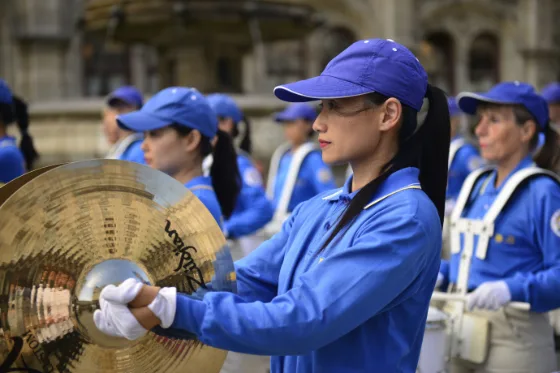
Steadfast on the path of cultivation alongside the Tian Guo Marching Band
Greetings respected Master, greetings fellow practitioners.
Read more »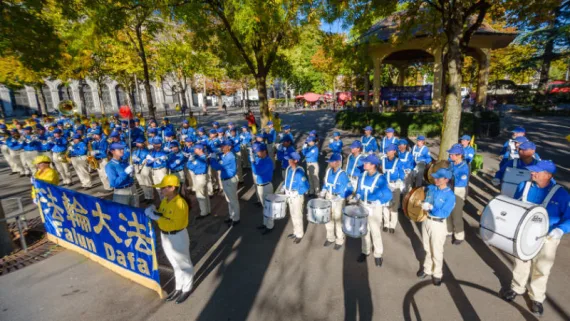
Cultivation as a Member of the Tian Guo Marching Band
Dear Master, dear fellow practitioners,
Read more »
Prioritizing cultivation and the salvation of living beings
Greetings to Master. Greetings to fellow practitioners.
Read more »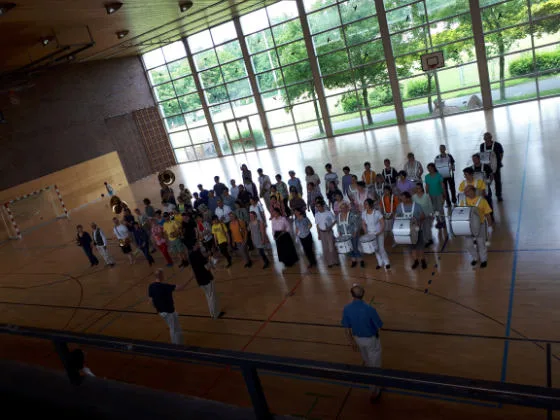
A Trumpeter's Growth path - Continuously improve skills and contribute to the whole Band
Greetings fellow practitioners of the Tianguo Marching Band.
Read more »
After Righteous Enlightenment I became a Tianguo Marching Band Member
Greetings to our graceful Master, greeting fellow practitioners. I would like to report to our Master my cultivation journey of joining the band, improving my xinxing and taking responsibility in this...
Read more »
How joining the Tianguo Marching Band changed me
I was born into a family of Falun Dafa practitioners, and from a young age my parents told me that “Dafa is good” and that cultivation is very important. When I was little, they often studied the Fa a...
Read more »